Research Highlights
Dr. Mohsin Saleem from NUST has pioneered a green and sustainable approach to synthesize high-quality PZT ceramics by recycling lead oxide (PbO) extracted from discarded lead-acid batteries. The resulting material achieved 99% densification with superior dielectric properties, demonstrating an innovative pathway toward environmentally responsible electronic materials production.
📄 Read the full research: https://pubs.acs.org/doi/10.1021/acsomega.5c00071
#NUST #SustainableMaterials #GreenTechnology #Ceramics #BatteryRecycling #MaterialsScience #NUSTResearch #CircularEconomy
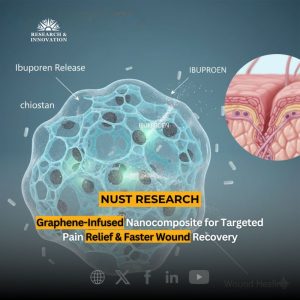
Prof. Dr. Zakir Hussain from NUST has developed a biodegradable nanomaterial composed of chitosan, MOF-199, and graphene quantum dots for the controlled delivery of ibuprofen. The material demonstrates a 58.3% drug loading capacity, enables sustained release over 72 hours, exhibits strong antibacterial activity, and remains biocompatible with healthy cells — making it a promising platform for safe and efficient drug delivery.
📄 Read the full research: https://www.sciencedirect.com/science/article/pii/S1773224725008603?via%3Dihub
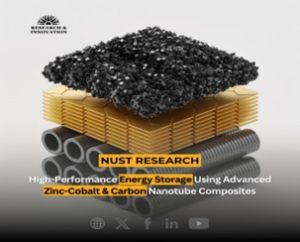
Dr. Sofia Javed from the Dept. of Materials Engineering, SCME has developed a ZnCo₂O₄/WS₂/FCNTs ternary nanocomposite electrode for supercapacitors. It delivers 540.5 C/g specific capacity, 55 Wh/kg energy density, and 87% retention over 10,000 cycles — a high-performance, durable solution for energy storage.
📄 Read the full research paper: https://doi.org/10.1016/j.jallcom.2025.182876
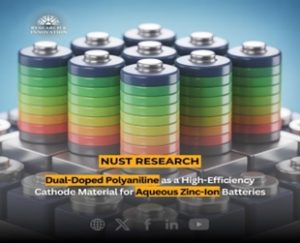
Dr. Muhammad Sajid Dept. of Chemical Engineering, SCME in collaboration with Northeast Normal University, has developed co-doped polyaniline cathodes for aqueous zinc-ion batteries. The work achieves 200.7 mAh/g capacity and 90% retention after 10,000 cycles — a durable, efficient, and eco-friendly energy storage solution.
📄 Read the full research paper: https://doi.org/10.1016/j.jcis.2025.138600
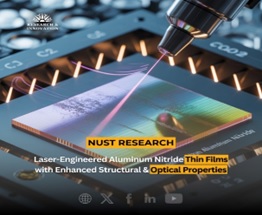
Dr. Mohsin Saleem from the Dept. of Materials Engineering, SCME, in collaboration with Chung Ang University (CAU), demonstrated a CO₂ laser-assisted RF sputtering technique to deposit high-quality Aluminum Nitride thin films — without the need for post-annealing. With enhanced crystallinity, bandgap, and high transmittance, this work paves the way for next-generation electronics and DUV optoelectronics.
📄 Read the full research paper: https://doi.org/10.1016/j.matchemphys.2025.131136
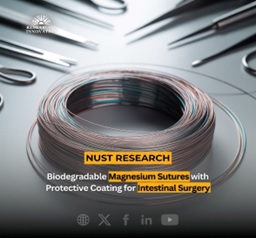
Dr. Shoaib Butt and his team from Dept. of Materials Engineering, SCME introduced a dual-layer coated magnesium (Mg) suture with enhanced tensile strength, antibacterial properties, and optimal biocompatibility — addressing postoperative infections and corrosion issues in gastrointestinal surgeries.
📄 Read the full research paper: https://doi.org/10.1016/j.ijbiomac.2025.144162
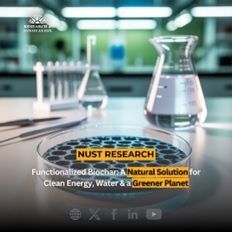
Dr. Nouman Aslam and his team from Dept. of Chemical Engineering, SCME, in collaboration with Karlstad University, studied the role of functionalized biochar in sustainable energy, wastewater treatment, CO₂ reduction, and achieving carbon neutrality — highlighting its versatility for a cleaner future.
📄 Read the full research paper: https://doi.org/10.1007/s42773-024-00316-3
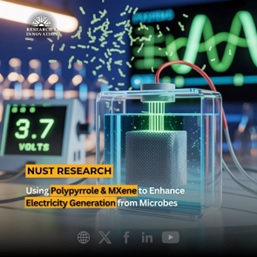
Dr. Waheed Miran and his team from Dept. of Chemical Engineering, SCME enhanced microbial fuel cell output using a polypyrrole/MXene composite anode, achieving 264 mW/m² power density — a 5.8× increase over unmodified electrodes.
📄 Read the full research paper: https://doi.org/10.1007/s10800-025-02275-4
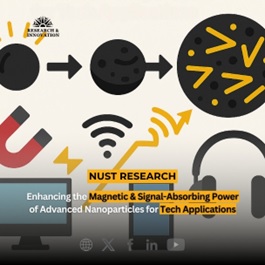
Dr. Iftikhar Hussain from Dept. of Materials Engineering, SCME has developed nanoparticles made from strontium and enhanced with cobalt and zirconium. These materials can absorb microwave signals, making them useful for stealth technology and radar concealment.
📄 Read the full research paper: https://doi.org/10.1016/j.ceramint.2024.11.451
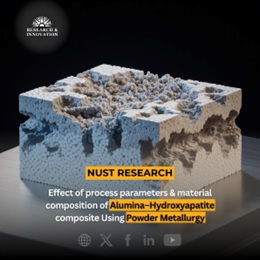
Dr. Adeel Umer from Dept. of Materials Engineering, SCME NUST developed Al₂O₃–HAP biomedical composites using powder metallurgy and vacuum sintering to balance mechanical strength and biocompatibility. A composition of 70% Al₂O₃ and 30% HAP demonstrated ideal properties for load-bearing implants. ScienceDirect | QS World University Rankings
Read full research :https://doi.org/10.1016/j.rinma.2025.100669