

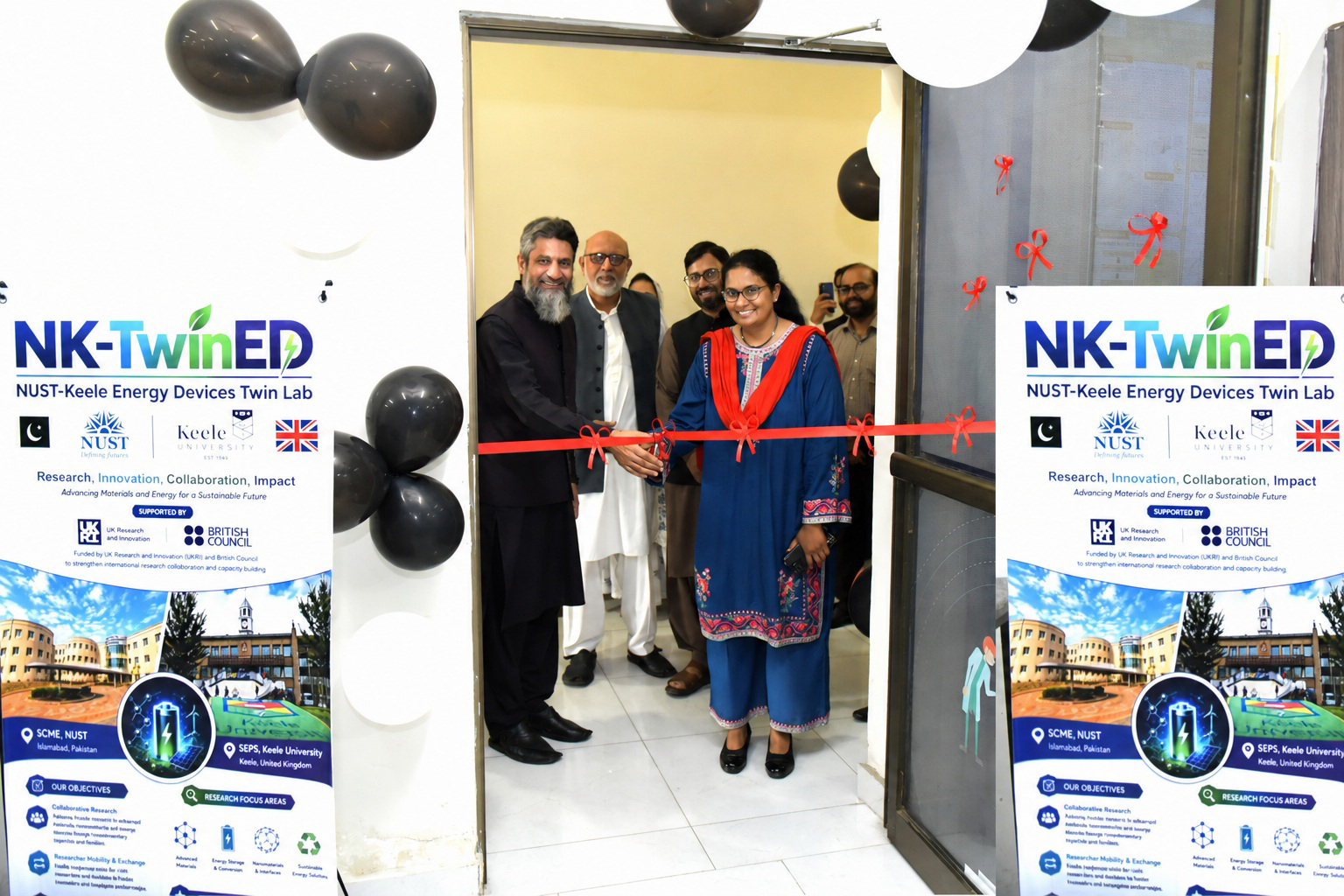
NUST–Keele Energy Devices Twin Lab (NK-TwinED) Inaugurated at SCME
-The National University of Sciences and Technology (NUST), Pakistan, and Keele University, United Kingdom, have taken another significant step towards strengthening their academic and research collaboration through the establishment of the NUST–Keele Energy Devices Twin Lab (NK-TwinED).
The initiative brings together researchers from the School of Chemical and Materials Engineering (SCME), NUST, and the School of Chemical and Physical Sciences, Keele University, with a shared vision of advancing collaborative research, innovation, and capacity building in the field of advanced materials and energy storage devices.
The establishment of NK-TwinED builds upon the growing collaboration between the two institutions, particularly in the areas of functional materials, electrochemical energy storage, sustainable technologies, and advanced energy devices. The Twin Lab was formally inaugurated during the visit of Dr Nilanthy Balakrishnan from Keele University to NUST, marking an important milestone in strengthening institutional linkages between Pakistan and the United Kingdom.
At the heart of this initiative is the concept of two interconnected research environments at NUST and Keele University, designed to facilitate the exchange of knowledge, expertise, research facilities, and human resources. NK-TwinED will provide a collaborative platform for researchers and students to work jointly on challenges related to next-generation batteries, supercapacitors, sustainable energy materials, and other emerging energy technologies.
The Twin Lab will also promote opportunities for joint research proposals, collaborative publications, student and faculty exchanges, joint supervision of postgraduate students, training programmes, workshops, and access to complementary research facilities at both institutions.
During her visit to Pakistan, Dr Nilanthy Balakrishnan held a series of productive meetings with faculty members and researchers at NUST to explore future collaborative initiatives. Discussions focused on the development of joint research projects, enhanced postgraduate supervision, mobility opportunities, and broader institutional partnerships.
The visit also provided an opportunity to discuss potential initiatives related to dual degree programmes and strengthened academic cooperation between universities in Pakistan and Keele University. These discussions reflect the commitment of both institutions towards developing sustainable and long-term mechanisms for international academic engagement.
The establishment of NK-TwinED is expected to create new opportunities for students and researchers by providing exposure to international research environments and encouraging interdisciplinary collaboration. Through joint access to expertise and research infrastructure, the initiative aims to contribute towards the development of highly skilled researchers capable of addressing global challenges in energy and sustainability.
The collaboration is supported by the shared commitment of NUST and Keele University towards research excellence, innovation, internationalisation, and impactful partnerships. By combining their complementary strengths, the two institutions aim to develop a vibrant platform for knowledge exchange and collaborative research with meaningful scientific and societal impact.
Speaking on the occasion, the participants expressed optimism that the NUST–Keele Energy Devices Twin Lab (NK-TwinED) would serve as a foundation for expanded cooperation between the two institutions in the coming years.
The establishment of NK-TwinED represents not only a new chapter in the NUST–Keele partnership but also a step towards strengthening Pakistan–UK collaboration in advanced materials and sustainable energy research. It is anticipated that the initiative will lead to joint research projects, enhanced student opportunities, international mobility, and innovative solutions for future energy challenges.